
Mullein the Cloud Medicine
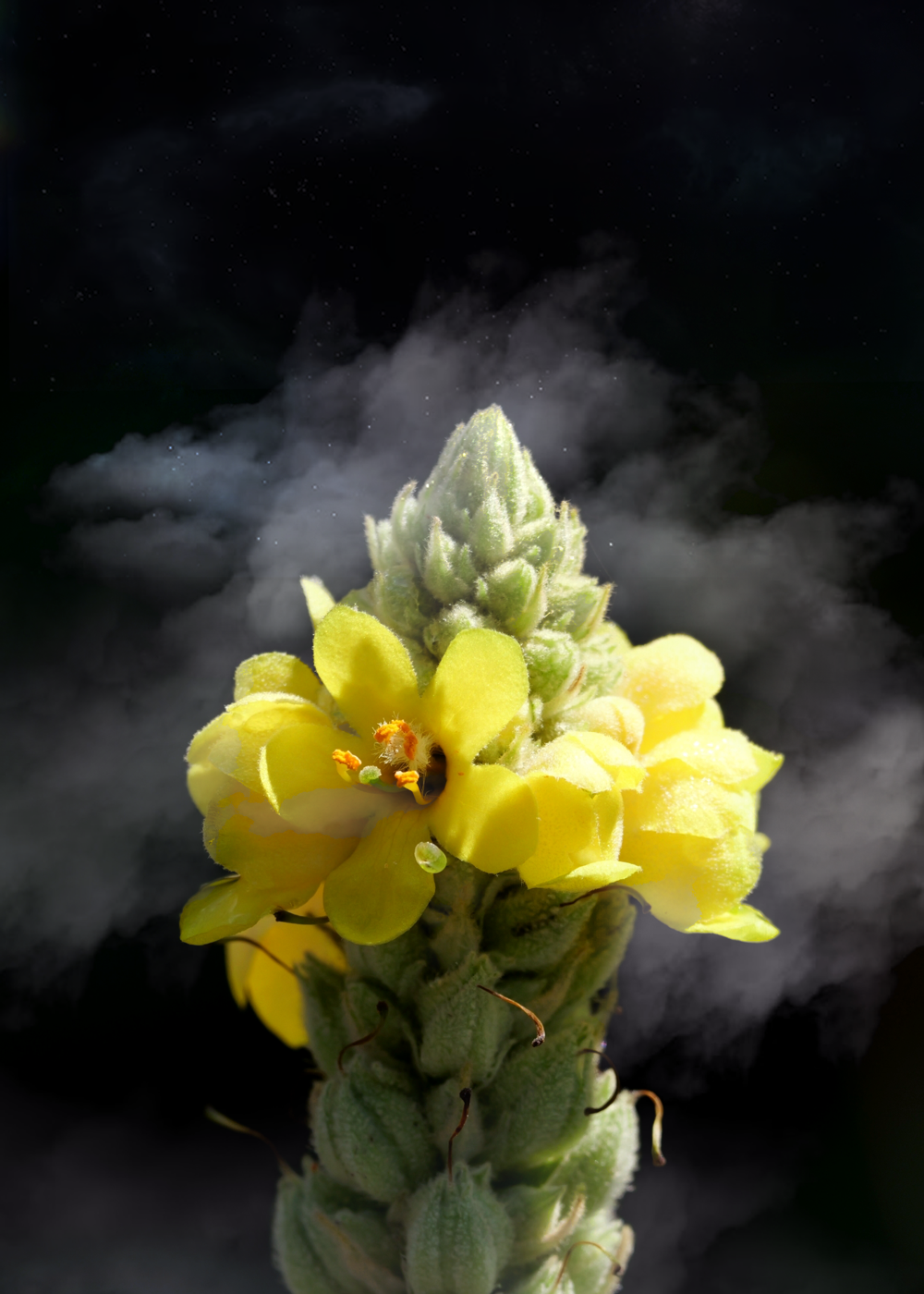
Mullein stands proud in open fields, confident, yet soft and approachable in spirit. A member of the snapdragon family, it carries the power and protective energy of the dragon. A quiet sentinel, who stands watch.
The herb is known for its soft strength, dispelling stagnant and heavy energy while encouraging inner stillness. Cherished in tradition for guiding and protecting the breath of life, it has traveled from Europe across continents, where it is turned to for healing wherever it grows.
Mullein as
Time Keeper
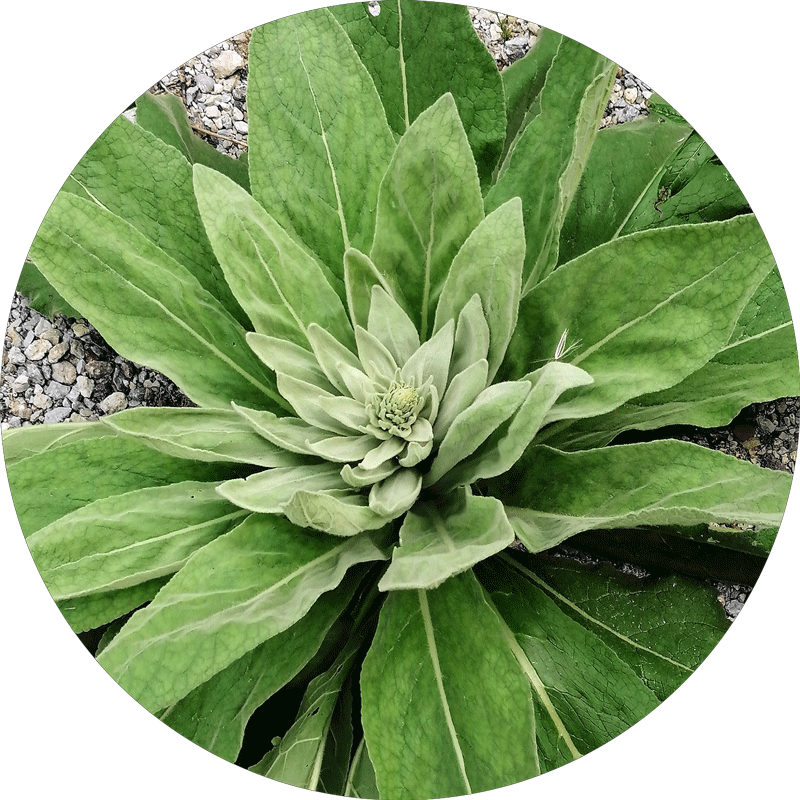
Mullein holds time. It doesn’t rush; it asks for patience, slow to rise, and long to bloom. It’s biennial in cycle, meaning it lives for two years. During its first year, it forms a rosette of soft, fuzzy leaves low to the ground; during its second year, it shoots up a stalk that rises tall. This patient growth teaches us to honor timing and trust what unfolds in due season.
The stalk is a kin to the spine, and the spine belongs to Saturn – Lord of Capricorn, ruler of structure, boundaries, and the axis upon which we carry ourselves. Those that have challenges with alignment, posture, and balance may find guidance in Mullein’s steady form. It’s the type plant that says ~ stand up straight and put your shoulders back. The plant’s deep taproot stretches into the earth, anchoring and drawing nourishment, while its stalk reaches for the clouds, bridging realms.
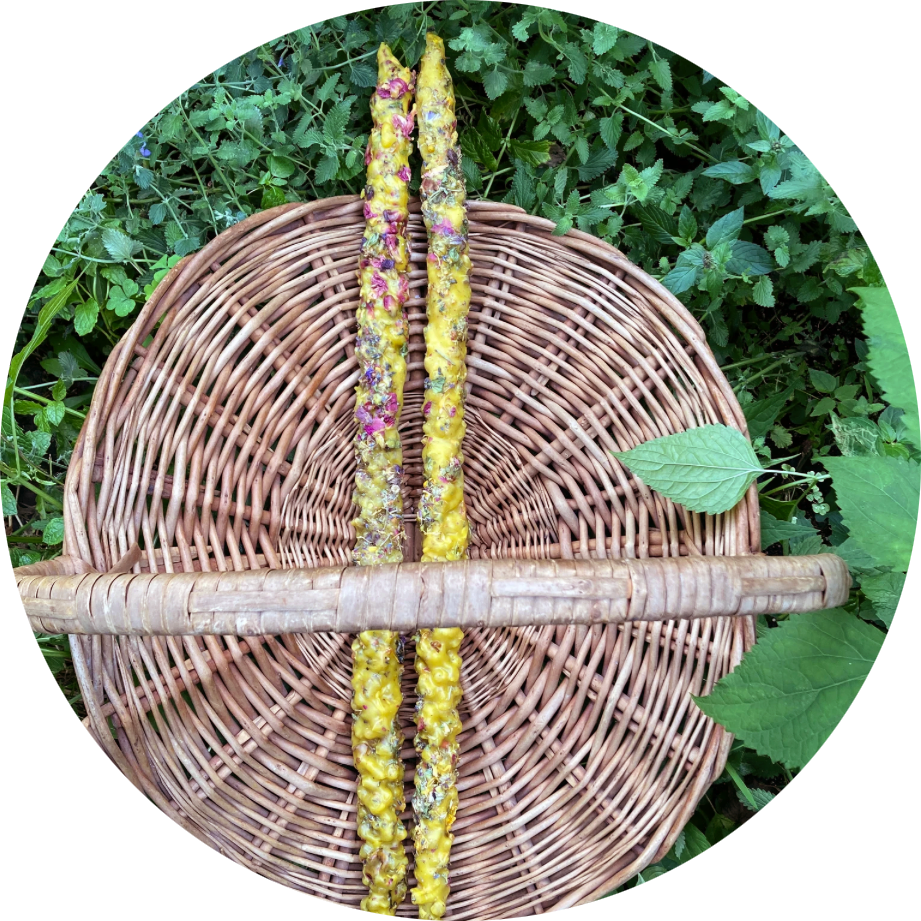
Hand dipped Mullein torches from Wild Mothers Offerings.
Mullein as
Torch
Fire + Air
Mullein’s tall, dried stalks were once dipped in tallow and lit as torches, earning it the name Hag’s Taper or Witch’s Candle – tying it to light, guidance, and protection in old lore. Lighter than a solid wood torch, its stalks were ideal for long journeys, bringing fire and guardianship to travelers.
Its smoke clears the stagnant, carrying away what no longer belongs, stirring breath, voice, and inner fire back into motion. It teaches us to breathe through hardship and reclaim our strength. As medicine, it loosens the weight of stuck mucus, opens the airways with ease, cleanses both air and tissue with its antimicrobial smoke, and, when warmed in oil, soothes the ache of nerves and muscle. This is Mullein as torch – illuminating the path, warming the breath, and clearing the way.
Mullein as
Basin
Water + Air
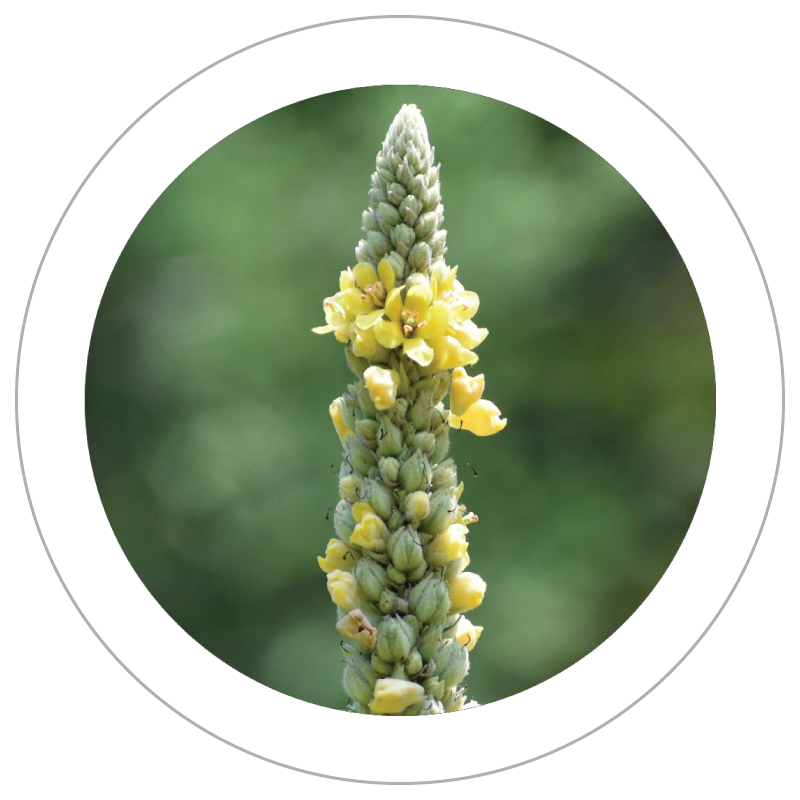
Mullein’s central stalk is wrapped in soft, silvery leaves and crowned with delicate yellow flowers, a living emblem of gentle strength. In the unseen, it eases grief held in the lungs, whispering: you can carry this, but you do not have to carry it alone.
This is Mullein as basin – holding and soothing, creating space for breath to deepen and soften. It helps sorrow move on the exhale, brings stillness to the chest, and encourages release with tenderness rather than force. In the body, it coats dry mucous membranes of the lungs, throat, and sinuses, calms inflammation, and eases the harsh edge of coughs. With its bright yellow flowers, it moves the lymph and speaks to the waters of the body *kidneys, bladder, and the urinary stream* reminding us of flow, cleansing, and release.
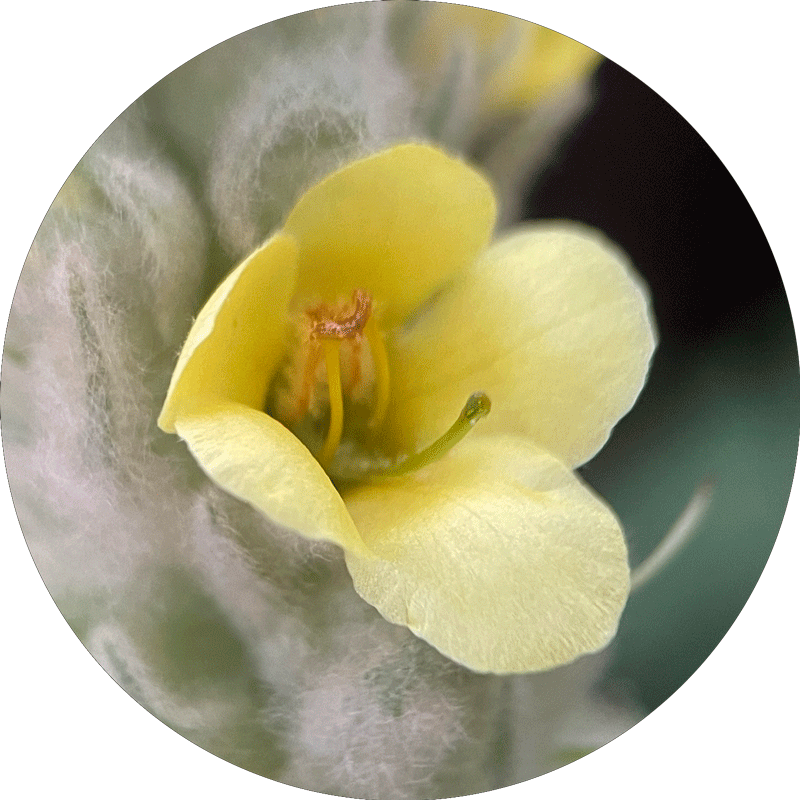
You can carry this, but you do not have to carry it alone.
Verbascum thapsus
FAMILY SCROPHULARIACEAE
GENUS VERBASCUM
Element
 Air
Air Fire
Fire
POLARITY
 YIN / Receptive
ENERGY WHEEL
 Throat
ARCHETYPE
 The Guardian
CELESTIALS
 Saturn
 Capricorn
 Waning Moon
GIFTS
 Breath Clearing Courage Soft Strength Protection Grounding Stillness
Domain
 Repiratory
 Urinary
 Spine
Spine Ears
Ears
Energetics
Leaves + Flowers Cooling
 Moistening
Roots Warming
 Drying
Tissue States
Leaves + Flowers Dry Atrophy
 Constricted
Roots Damp Stagnant Constricted
Flavor
 Bitter
 Astringent
Aroma
 Earthy
INDICATIONS
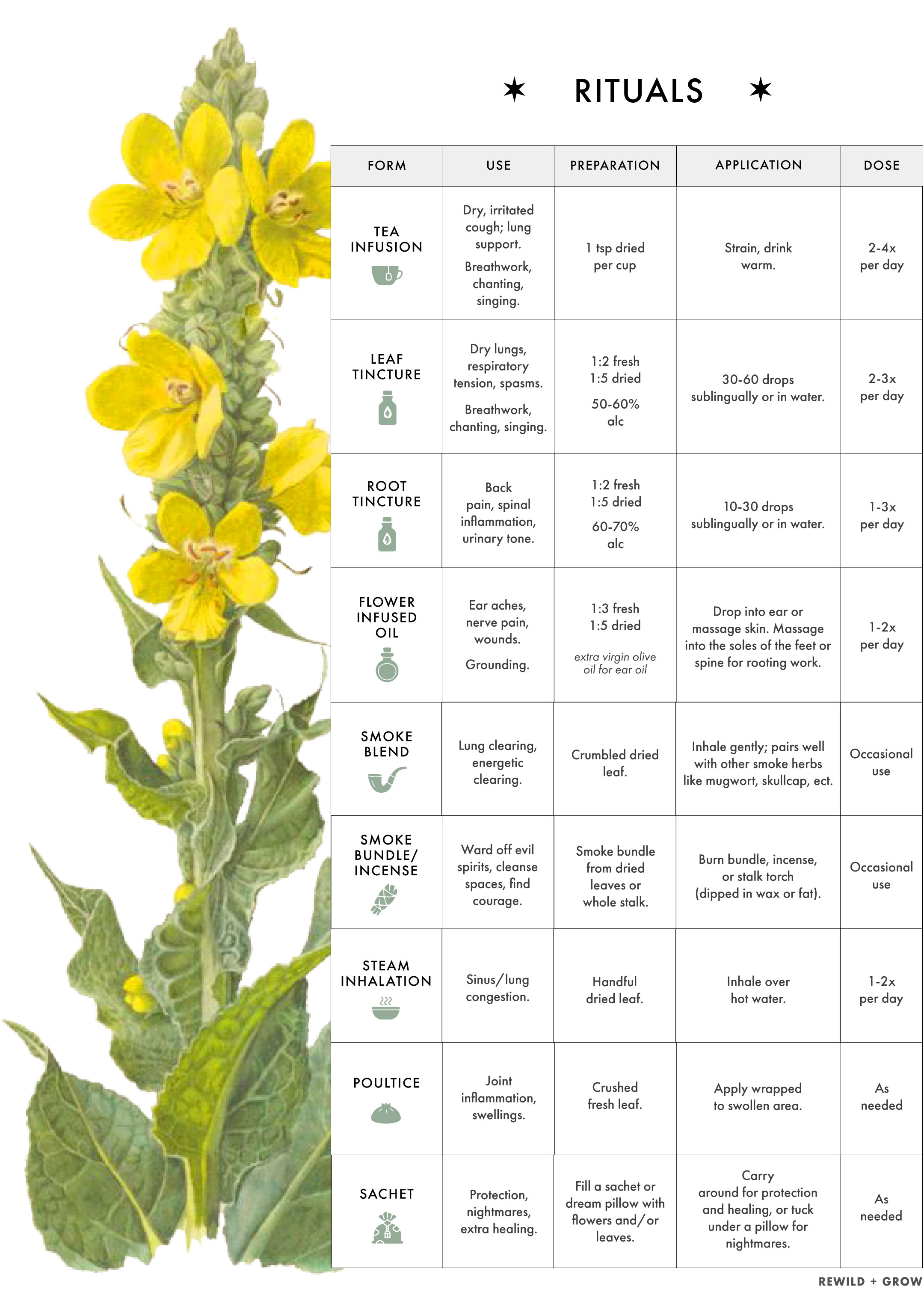
Dry, Hacking Coughs ✸ Chest Congestion ✸ Asthma Tightness ✸ Lost Voice ✸ Ear Infections ✸ Swollen Lymph ✸ Spinal Misalignment & Tension ✸ Urinary Irritation ✸ Inflamed Skin ✸ Grief in the Chest ✸ Energetic Collapse ✸ Suppressed Expression
ACTIONS
LEAVES Expectorant ✸ Antitussive Antispasmodic ✸ Demulcent Astringent ✸ Anti-inflammatory ✸ Analgesic ✸ Alterative ✸ Diuretic ✸ Emollient ✸ Vulnerary
FLOWERS Analgesic ✸ Anti-inflammatory ✸ Demulcent ✸ Nervine ✸ Sedative
ROOTS Anti-inflammatory ✸ Anti-spasmodic ✸ Diuretic ✸ Nervine




MUSCULOSKELETAL
Root, Flower
Alleviates inflammation, softens stiffness, and soothes aching tissues.

COMPANION HERBS
✸ MARSHMALLOW ROOT enhances demulcent effect
✸ LICORICE ROOT harmonizer, moistens & supports adrenal/lung connection
✸ ELECAMPANE deeper lung decongestant for stuck phlegm
✸ THYME antimicrobial expectorant, especially in wet lungs
✸ SKULLCAP nervous system support, especially emotional
✸ CALIFORNIA POPPY nervous system support, especially emotional
✸ COLTSFOOT softens chronic/dry coughs (short term only)
CAUTION

✸ Ear oil should not be used if the eardrum is perforated. ✸ Unfiltered infusions may irritate the throat due to fine hairs – strain thoroughly through a cloth or coffee filter.
✶ HARVEST ✶
LEAVES
YEAR 1 | HIGH SPRING
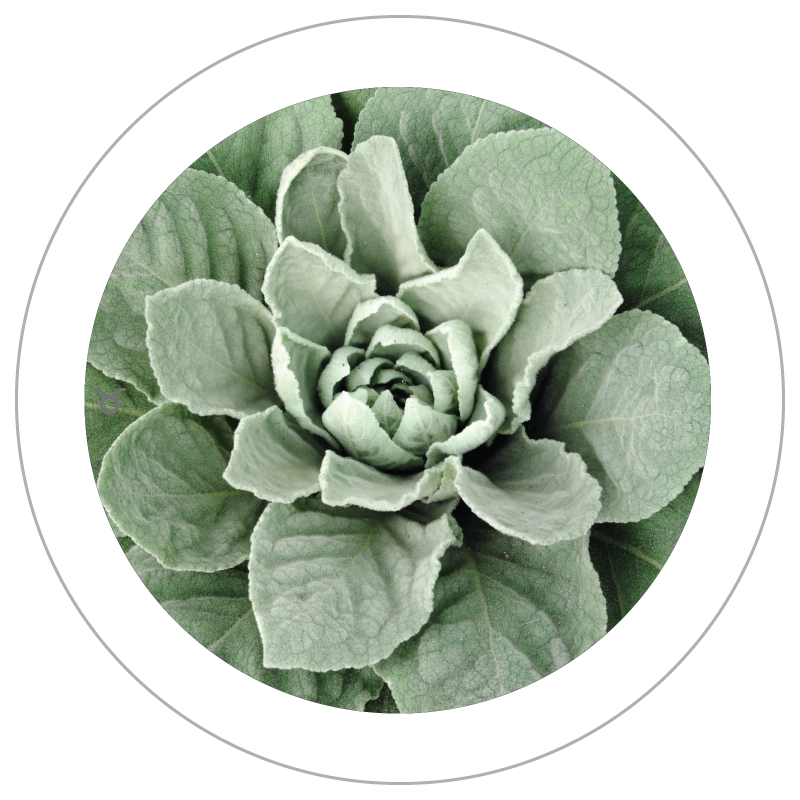
During Mullein’s first year, she forms a rosette of soft, fuzzy leaves (due to dense trichomes). Between high spring to summer’s end is the best time to harvest leaves, as the plant’s energy is concentrated in the basal foliage, before the plant sends up a stalk during its second year.
ROOTS
YEAR 1 | LATE FALL
YEAR 2 | EARLY SPRING
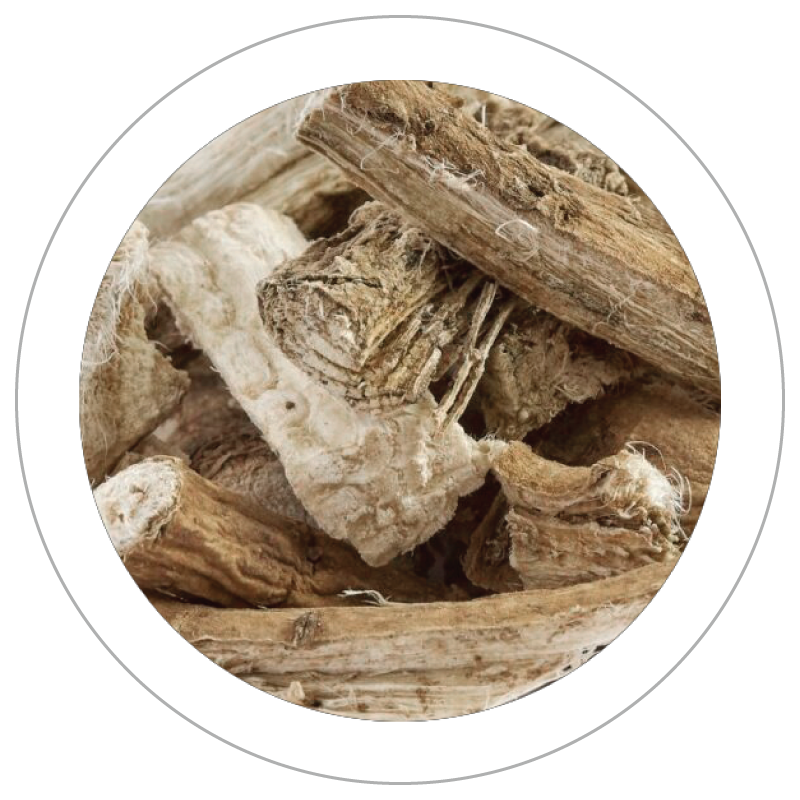
Roots can be harvested in late fall during Mullein’s first year. In the second year, they should be harvested in early spring before the plant directs its energy toward stalk and flower production. Roots from first-year plants are generally preferred, as they are denser and more vital.
FLOWERS
YEAR 2 | SUMMER
During Mullein’s second year, she sends up a tall flowering stalk that blooms from the bottom upward throughout the summer. Flowers can be harvested daily over several weeks, as they open gradually. They are best picked on dry mornings for best quality. This is also when stalks can be harvested to use as torches (typically dipped in wax or fat).
SEEDS
YEAR 2 | SUMMER’S END
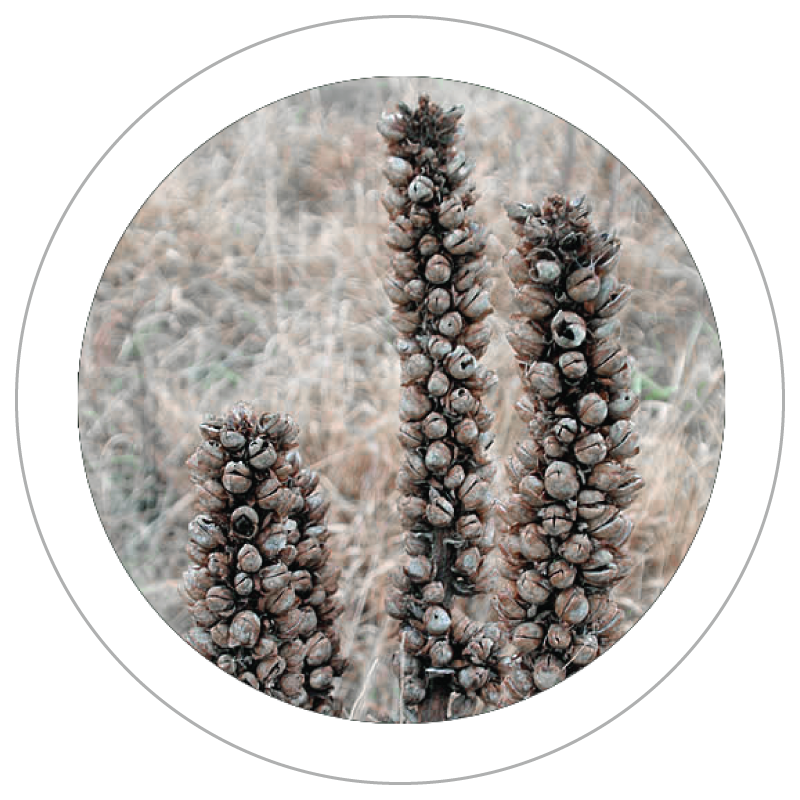
Unless you live where Mullein is native, you likely won’t be harvesting its seeds, as the plant is considered invasive in many regions and can disrupt local ecosystems if unmanaged. If you do live in its native range, seeds form in the fall of the second year, following flowering.
✸
MISPLACED
MULLEIN
Mullein hails from Europe, North Africa, and Asia. It was brought to North America by early colonists and is considered invasive. It quickly adapts through prolific seed production – one plant can yield tens of thousands of seeds! It outcompetes native plants in open, sunny spaces and thrives in disturbed ground.
✸
HARVEST
WITH CAUTION
Mullein’s deep taproot is notorious for pulling toxins from the soil, so caution is needed when harvesting for medicine. Always choose plants from clean, healthy soil, and avoid roadsides, industrial sites, or areas that may contain contaminants such as heavy metals or agricultural runoff.
✸
HARVEST
RESPECTFULLY
Mullein is a victim of misplacement, and because it is considered invasive, harvesting is encouraged to manage its spread. Mullein that cannot be used medicinally should be gently uprooted and laid down softly to return to the earth – unless it has gone to seed, in which case it should be burned.


SOURCES
PREVIOUS
NEXT
Medical Disclaimer
I am not a medical professional.
Rewild + Grow is for informational purposes only. The FDA has not evaluated these statements, and they are not intended to diagnose, treat, or cure any disease. Consult your healthcare provider if you have any concerns, especially if you're pregnant, breastfeeding, or taking medication.
Affiliate Disclaimer
This website is supported by its audience and contains affiliate links. An affiliate link means I may earn advertising or referral fees at no extra cost to you if you make a purchase through these links.


0 Comments